Infrastructure Overview
Uganda's tourism infrastructure has undergone significant development in recent years, with substantial investments in accommodation, transportation, and digital connectivity enhancing the visitor experience.
The country's infrastructure development strategy focuses on sustainable growth, ensuring that tourism expansion supports conservation efforts while providing world-class facilities for visitors. Current infrastructure supports over 1.6 million annual visitors with room for strategic expansion.
Key infrastructure developments include the expansion of Entebbe International Airport, improvement of road networks to major tourist destinations, and the rollout of high-speed internet connectivity across tourism zones.
Infrastructure Highlights
- 20,400 total accommodation rooms
- 2 international airports
- 85% road network coverage
- 68% digital connectivity
- $288M annual investment
Accommodation Infrastructure
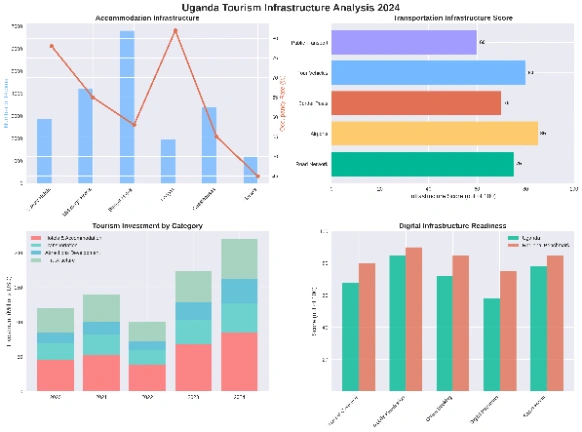
Accommodation Capacity Analysis
Uganda's accommodation sector offers diverse options from luxury safari lodges to budget-friendly hostels, with a total capacity of over 20,400 rooms across different categories.
Luxury Hotels
2,850 rooms
78% occupancy
Safari Lodges
1,950 rooms
82% occupancy
Mid-range Hotels
4,200 rooms
65% occupancy
Guesthouses
3,400 rooms
55% occupancy
Budget Hotels
6,800 rooms
58% occupancy
Hostels
1,200 rooms
45% occupancy
Transportation Infrastructure
Airports
Score: 85
Tour Vehicles
Score: 80
Road Network
Score: 75
Border Posts
Score: 70
Public Transport
Score: 60
Digital Infrastructure Readiness
Digital infrastructure is crucial for modern tourism operations, from online bookings to social media marketing and digital payments. Uganda has made significant strides in digital connectivity.
Internet Coverage
Tourism areas connectivity
Score: 68%
vs 80% benchmark
Mobile Penetration
Mobile network coverage
Score: 85%
vs 90% benchmark
Online Booking
Digital booking platforms
Score: 72%
vs 85% benchmark
Connectivity Projects
- • National fiber optic backbone
- • 4G/5G network expansion
- • Free WiFi in tourism zones
- • Satellite internet for remote areas
Digital Services
- • Mobile payment integration
- • Digital tourism platforms
- • Online visa processing
- • Virtual tour experiences
Tourism Infrastructure Investment
Tourism infrastructure investment has shown consistent growth, with both public and private sector participation driving development across accommodation, transportation, and digital infrastructure.
2024 Investment by Category
Investment Sources and Partnerships
42%
Private Sector
35%
Government
23%
International
Challenges and Opportunities
Key Challenges
- Limited road infrastructure to remote attractions
- Inconsistent internet connectivity in rural areas
- Seasonal capacity constraints during peak periods
- Skills gap in hospitality and digital services
- Limited public transportation options
Growth Opportunities
- Eco-lodge development in national parks
- Digital tourism platform integration
- Regional tourism corridor development
- Sustainable transportation solutions
- Smart tourism technology adoption
Future Development Plans
Short-term Goals(2024-2025)
- Complete airport expansion project
- Develop regional tourism circuits
- Improve road access to Bwindi
- Expand 4G network coverage
Medium-term Goals(2025-2027)
- Develop regional tourism circuits
- Implement smart city initiatives
- Upgrade accommodation standards
- Enhance border crossing facilities
Long-term Vision(2028-2030)
- Achieve 100% digital connectivity
- Complete infrastructure master plan
- Establish Uganda as regional hub
- Achieve carbon-neutral tourism
Experience Uganda's World-Class Tourism Infrastructure
From luxury safari lodges to digital connectivity, Uganda's infrastructure ensures a seamless travel experience. Apply for your eVisa and discover the Pearl of Africa.